
Settings
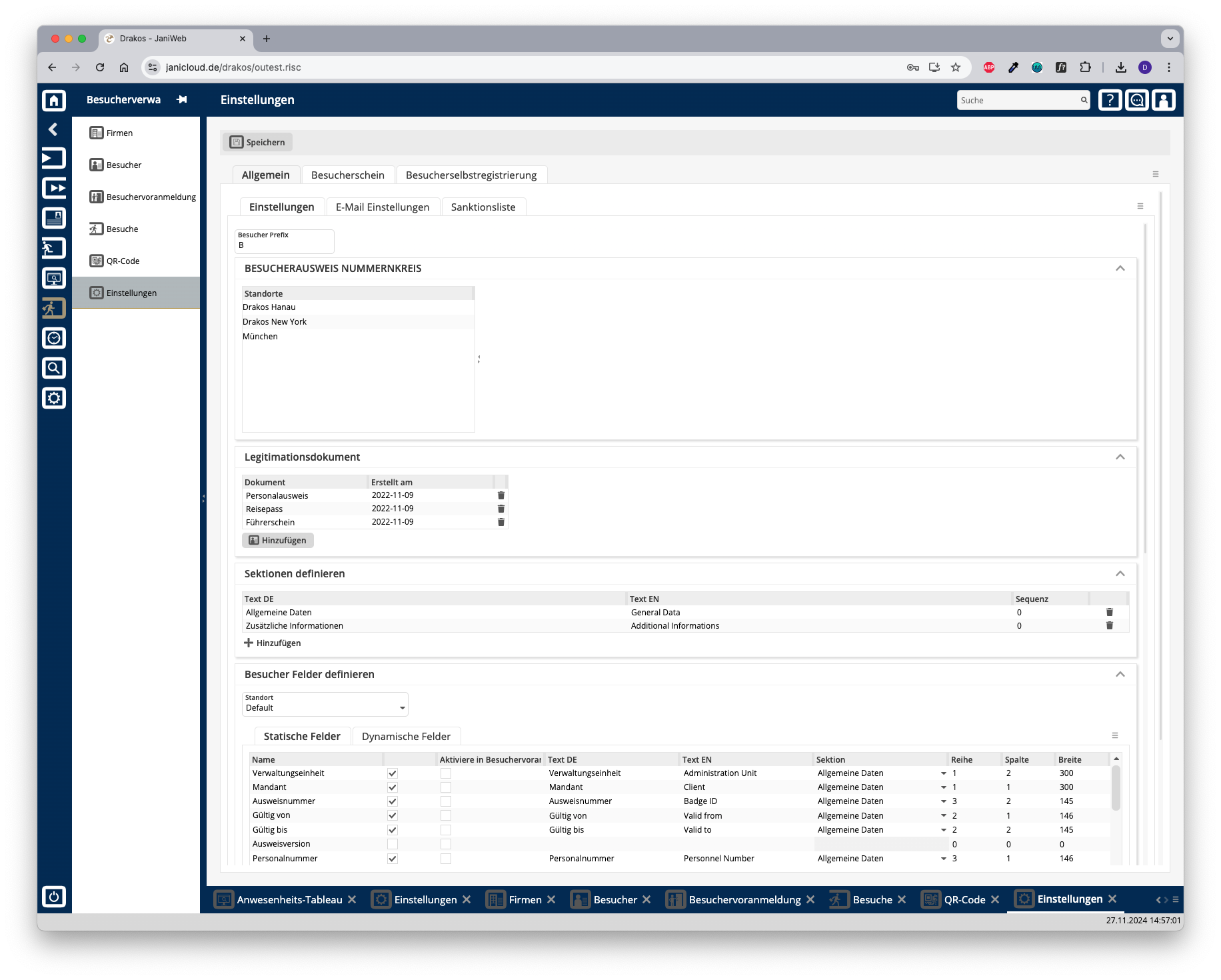
Use the menu item Settings to define the basic settings for visitor management. These include number ranges, visitor ID layouts and the fields to be displayed.
Button Save
Press Save to apply your changes.
Tab General > Settings
In the field Visitor ID Prefix, define the prefix for visitor personnel numbers.
Area Ranges for Visitor ID Cards
Define the number ranges for visitor ID cards. Create a separate definition for each plant. You can either specify a range (From card number / To card number) for all visitor ID cards or create individual numbers under ID Cards.
Area Legitimisation Documents
Define the documents that should be available for selection in the field Legitimisation Document for Visits.
Area Areas
Here you determine which areas appear in the menu item Visitors. When you select the visible fields for visitors (Fields Visitor), specify where the corresponding field is displayed by selecting one of the areas defined here.
To create a new area, perform the following steps:
Enter a number in the Order column to determine the order in which the areas are displayed.
When creating a new area, you must first save it before you can assign a field to it.
Area Fields Visitor
This is where you manage the fields for the menu item Visitors.
List field Plant
You can define the visibility and positioning of the fields separately for each plant. Select the plant for which the settings in this area should apply.
The fields displayed to the user depend on the plant assigned to the user. If no plant is assigned to a user, the settings for the Default plant are used. To assign plants to a user, use the Settings in the main menu, menu item Users.
Tab Static Fields
Specify which fields are visible (check box in the second column) and where they are positioned (Row, Column, Width).
To define the name for a field, press Translate. Enter the names for the respective languages and press Save.
In the column Registration, you can define whether the respective field also appears in the visitor Registration.
Tab Dynamic Fields
Here you can define up to 20 dynamic fields. For each dynamic field, specify whether it should be a list field (drop-down), a date field, a checkbox or a free text field.
To define the name for a field, press Translate. Enter the names for the respective languages and press Save.
Area Fields Visits/Registration
Here you manage the fields for the menu items Registration and Visits.
List field Plant
You can define the visibility and positioning of the fields separately for each plant. Select the plant for which the settings in this area should apply.
The fields displayed to the user depend on the plant assigned to the user. If no plant is assigned to a user, the settings for the Default plant are used. To assign plants to a user, use the Settings in the main menu, menu item Users.
Tab Static Fields
Specify which fields are visible (check box in the second column) and where they are positioned (Row, Column, Width).
To define the name for a field, press Translate. Enter the names for the respective languages and press Save.
In the column Mandatory, you can specify whether the entry in the respective field is mandatory.
Tab Dynamic Fields
Here you can define up to 20 dynamic fields. For each dynamic field, specify whether it should be a list field (drop-down), a date field, a checkbox or a free text field.
To define the name for a field, press Translate. Enter the names for the respective languages and press Save.
In the column Mandatory, you can specify whether the entry in the respective field is mandatory.
Area Visible Buttons Visits
Use these options to specify which buttons should be visible in the Visits menu item.
Area Fields Invite Visitors
This is where you manage the fields for the menu item Invite Visitors (only visible to users with employee login).
Tab Visitor
Tab Static Fields
Specify which fields are visible in the area Visitor (checkbox in the second column) and where they are positioned (Row, Column, Width).
Tab Dynamic Fields
Here you can define up to 20 dynamic fields. For each dynamic field, specify whether it should be a list field (drop-down), a date field, a checkbox or a free text field.
To define the name for a field, press Translate. Enter the names for the respective languages and press Save.
Tab Visit
Tab Static Fields
Specify which fields are visible in the area Visit (checkbox in the second column) and where they are positioned (Row, Column, Width).
Tab Dynamic Fields
Here you can define up to 20 dynamic fields. For each dynamic field, specify whether it should be a list field (drop-down), a date field, a checkbox or a free text field.
To define the name for a field, press Translate. Enter the names for the respective languages and press Save.
Area QR Code
This is where you manage the FAAC barrier systems that should be available for selection in the menu item QR Code. To create a new barrier system, upload the corresponding init string into the system using the button Upload the initial string.
Area Additional Settings
This is where you define further settings for visitors.
Visitee additional Information: Select the additional information that should be available for the visitee.
Validity Visitors (Days): Enter the standard validity in days for visitors that were created via registration or the menu item Invite Visitors.
Tab General > Email
This is where you manage the settings for sending emails in visitor management.
List field Plant
You can define the email settings separately for each plant. Select the plant for which the settings in this area should apply.
List of documents
The documents stored in this list are attached to the confirmation email when visitors register.
Button Upload Documents
Select one or more PDF or image files on your computer to add them to the list.
Button Remove All
Deletes all documents. A confirmation dialog will appear.
Checkbox Visitor arrival notification
Use this to specify whether the person being visited will receive an email as soon as the visitor has arrived.
Area Email: Visitor Registration
Examples of email layouts
Sample layouts for emails in XML format:
Area Email: Delete Visit
Examples of email layouts
Sample layouts for emails in XML format:
Tab General > Sanctions List
You can activate the sanctions list check within visitor registration here. This checks whether the visitor created is on a sanctions list. Different information about the visitor can be checked for an entry on a sanctions list.
the information is not on the sanctions list (no check mark).
The sanctions list check is displayed in visitor registration if it is activated in the Additional Settings.
Tab Visitor Pass
Here you can manage different layouts for printing visitor passes. Select an entry in the list to display or change details.
To upload a new layout:
(Only layouts for the visit location are displayed in the menu item Visits.)
Press Upload new layout to upload an XML layout. Press Upload new logo to upload an image file with a logo. Press Save to apply the settings.
Save PDF in database: Use this to specify whether issued visitor passes are to be saved in PDF format in the database.
You can find a sample layout for a visitor pass here: SampleVisitorPassLayout.xml
TIPS
To create the layout, get in touch with your contact person.
Tab Visitor Registration Process
Use modules in this area to define the processes for visitor registration and for visitor check-in and check-out, independently for each plant.
Tab Registration
Registration allows your visitors to register independently at the reception. A visitor master record and a visit are created. On this tab, modules are used to define the registration process. Different processes can be specified for visitors and external companies.
Reordering modules: Drag the modules to the desired position. Editing modules: Use the edit icon to specify details such as the fields to be displayed for the respective module. Removing modules: Use the trash icon to remove a module from the process.
Overview of the modules
Language selection
This module displays a dialog for the visitor at the start of the registration process, where they can select the language of the user interface. To activate other languages in addition to German and English:
Visitor data
This module displays the input fields for visitor information. Select which fields are displayed and where they are positioned (Row, Column, Width). You must also specify the client with which the visitor master records are to be created.
PDF View
This module displays a PDF to the visitor. Select a language and press Upload new PDF to upload a PDF for that language.
Save PDF in database: Use this option to specify whether the PDF should be linked directly to the visitor master record.
Signature
This module prompts the visitor to sign. Press Set Signature Pad Text to define the text to be displayed in addition to the signature field for the respective language. Activate the option Use external signature pad if an external signature pad is connected. Leave the option disabled if the visitor is to use the mouse or the touchpad or touchscreen for the signature.
Print visitor pass
This module prints a visitor pass. To upload a PDF layout for the respective language, select the language and press Upload new layout.
Save PDF in database: Specify whether the visitor pass is linked to the visitor master record.
You can find a sample layout for a visitor pass here: SampleVisitorPassLayout.xml
XML View
This module displays a PDF with the information that the visitor has entered (e.g. name, email address). To upload a PDF layout for the respective language, select the language and press Upload new layout.
Save PDF in database: Use this option to specify whether the PDF should be linked to the visitor master record. Not visible: Specify whether the created PDF is displayed in the registration process. Accept: Specify whether the visitor must confirm the information in the displayed PDF.
You can find a sample layout in XML format here: SampleVisitorPassLayout.xml
End
This module displays a final text and sets the visit to either “Upcoming” or “Present”.
Message display duration (seconds): Use this option to specify how long the text should be displayed. Enter a whole number. Translate: Press this button to set the text that will be displayed in the respective language at the end of the registration process.
Use this module to specify the subject line and layout for the emails that are to be sent to the attended and visiting party at the end of the registration process.
Sample layouts for emails in XML format:
Visitor Type
The registration process can be defined separately for visitors or external companies. This module loads the process for a visitor or an external company.
Restriction Visitees
This module restricts the selectable visitees displayed in the module Visitor Data . The restriction is based on person groups.
To create a new person group:
(Optional) Add another criterion with value(s).
Logic of criteria and values
Criteria are linked logically by AND (all criteria must be met).
Plant
This module allows selection of the location for which the visitor registers. Define which plants should be available for selection during registration.
Access visitor registration using the following URL: https://{server}/janiweb/visit
Tab Check-in
The check-in is used by visitors who are already registered in the system and for whom a planned visit exists. Upon arrival, the visitor activates their visit by scanning a QR code.
Use modules on this tab to define the check-in process. Different processes can be specified for visitors and external companies.
Reordering modules: Drag the modules to the desired position. Editing modules: Use the edit icon to specify details such as the fields to be displayed for the respective module. Removing modules: Use the trash icon to remove a module from the process.
Overview of the modules
Visitor data
This module displays the input fields for visitor information. Select which fields are displayed and where they are positioned (Row, Column, Width). You must also specify the client with which the visitor master records are to be created.
Signature
This module prompts the visitor to sign. Press Set Signature Pad Text to define the text to be displayed in addition to the signature field for the respective language.Activate the option Use external signature pad if an external signature pad is connected. Leave the option disabled if the visitor is to use the mouse or the touchpad or touchscreen for the signature.
XML View
This module displays a PDF with the information that the visitor has entered (e.g. name, email address). To upload a PDF layout for the respective language, select the language and press Upload new layout.
Save PDF in database: Use this option to specify whether the PDF should be linked to the visitor master record. Not visible: Specify whether the created PDF is displayed in the registration process. Accept: Specify whether the visitor must confirm the information in the displayed PDF.
You can find a sample layout in XML format here:SampleVisitorPassLayout.xml
Use this module to specify the subject line and layout for the emails that are to be sent to the attended and visiting party at the end of the process.
Sample layouts for emails in XML format:
PDF View
This module displays a PDF to the visitor. Select a language and press Upload new PDF to upload a PDF for that language.
Save PDF in database: Use this option to specify whether the PDF should be linked directly to the visitor master record.
Visitor Type
The registration process can be defined separately for visitors or external companies. This module loads the process for a visitor or an external company.
End
This module displays a final text and sets the visit to either “Upcoming” or “Present”.
Message display duration (seconds): Use this option to specify how long the text should be displayed. Enter a whole number. Translate: Press this button to set the text that will be displayed in the respective language at the end of the registration process.
Access visitor registration using the following URL: https://{server}/janiweb/visit
Tab Check-out
Check-out is used by visitors who are already registered in the system and who have an active visit. Upon departure, the visitor checks out by scanning their QR code.
Drag the module Self-Checkout to the area of the respective plant. Use the edit icon to set a farewell text and the display duration in seconds.
Access visitor registration using the following URL: https://{server}/janiweb/visit